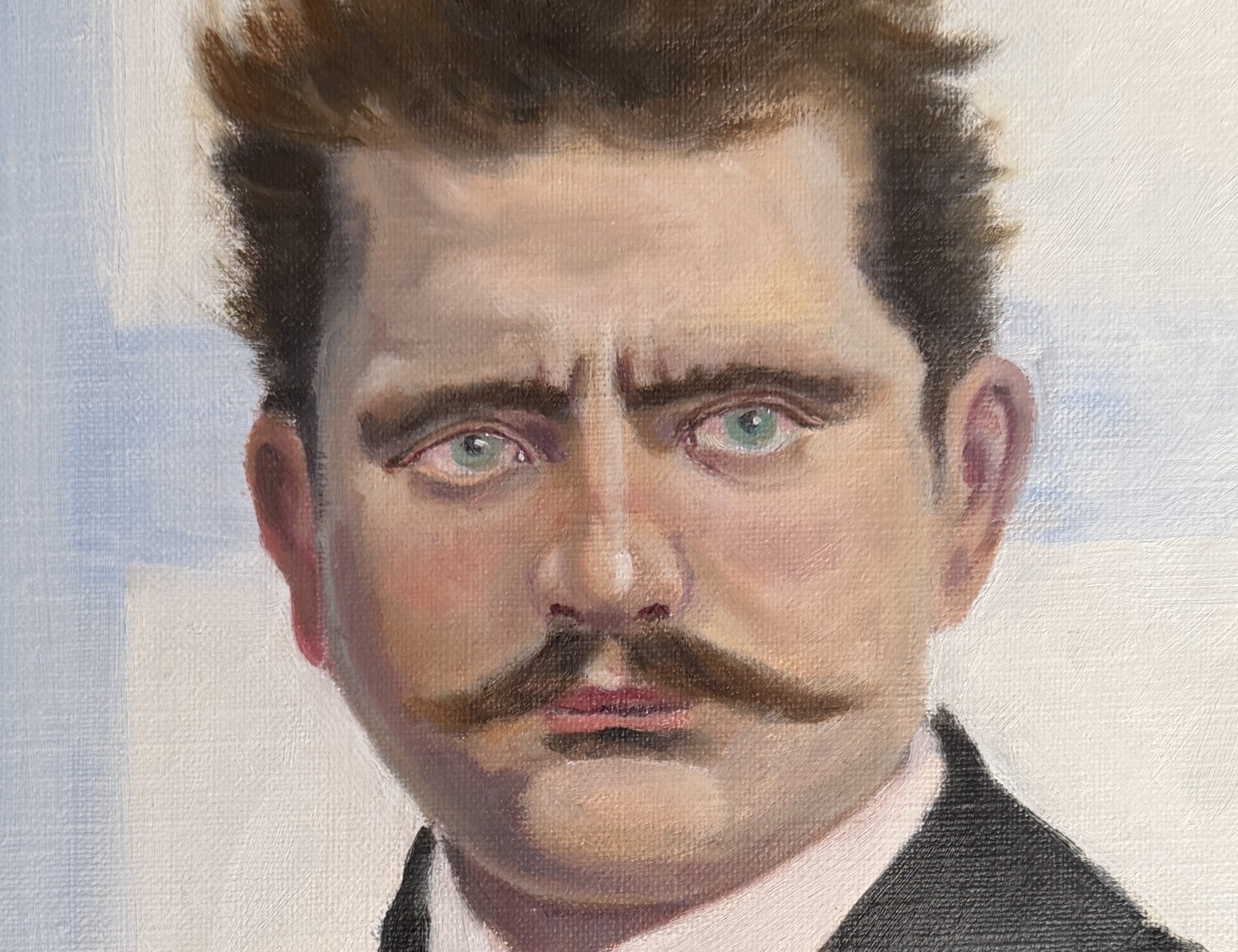
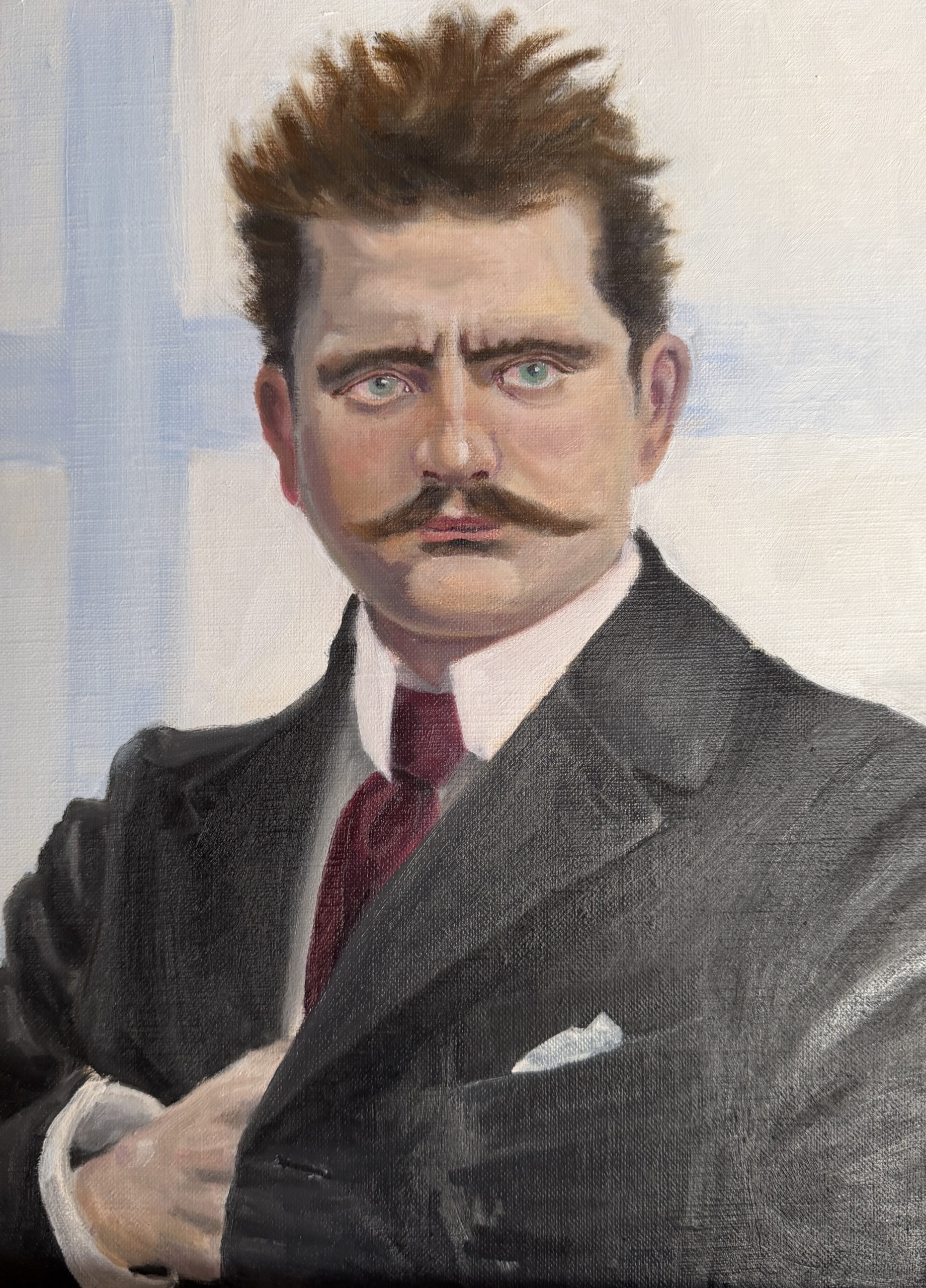
A portrait of Jean Sibelius (1865–1957), after the photograph below taken around 1898–1900.
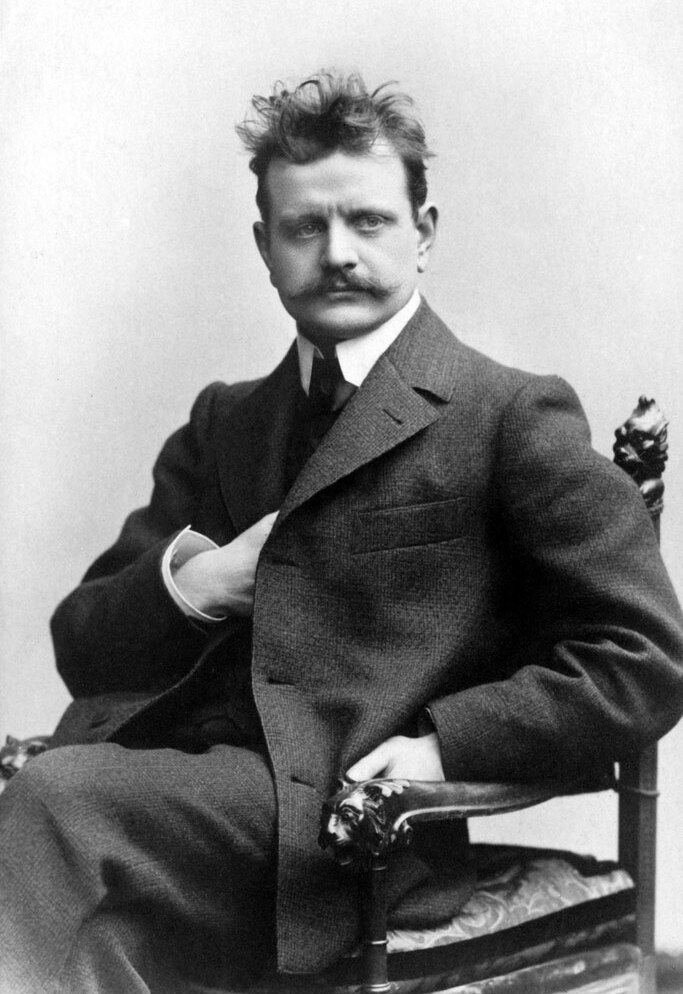
In his early thirties, Sibelius was rising as a national figure while living through one of the most intense and unstable periods of his life. His strong gaze, disordered hair, and the classic “hidden hand” pose reflect the tension of these years.
During this period, he completed the First Symphony (1899), which marked the beginning of his career as a symphonic composer, and released Finlandia (1899–1900), which soon became a symbol of the Finnish national movement.These works led to him being treated as a national hero in Finland.
Yet behind this public success, his private life was marked by heavy drinking, growing debts, and emotional strain.
The defining features of this portrait are:
- Disordered hair
Some researchers suggest that Sibelius added volume to his hair to hide a receding hairline, reflecting both vanity and personal insecurity.
The messy look may also hint at the disorder of his lifestyle during this period.
- Hidden hand
This pose—famously seen in portraits of Napoleon and widely used in the 19th century as a symbol of heroic or authoritative figures—can be read as a deliberate act of self‑presentation.
It suggests that Sibelius had begun to see himself in the role of a national composer.
- Tense expression
His expression reflects the pressure he faced as a composer, the expectations placed on him as a national figure, and the emotional shock of losing his daughter Kirsti in 1900. I’m adding a bit of redness around his nose, assuming he’s drunk, to suggest the confusion of a life marked by heavy drinking and nights of extravagant socializing, as well as the broader emotional turbulence that shaped his later years.
This portrait captures at once the face of a young hero and the face of a man holding himself together between uncertainty and bravado.
The inner conflicts of these years would later be transmuted into the depth and power of his music, leaving unmistakable traces in his symphonies and in the Violin Concerto.